 Modenetwork
 connects AI trading agents with an Ethereum Layer 2 DeFi ecosystem
Modenetwork combines AI trading agents with an Ethereum Layer 2 network built using the OP Stack. Mode Trade is its perpetuals exchange, launched in partnership with Orderly. The Mode AI Terminal helps prepare onchain transactions. Decentralized finance, or DeFi, covers financial applications that run through blockchain contracts. Those applications include exchanges and yield vaults, alongside tools that automate selected tasks. ETH pays network transaction fees, while MODE supports staking and votes for ecosystem protocols. The AI Quant adds market forecasting data from Synth. These components perform different jobs: the network executes transactions, applications provide financial functions and agents automate activity within their supported environments.
updatedWhat can you do on Mode beyond automated trading?
Mode supports token exchange, yield vaults, ETH restaking and MODE staking alongside its AI trading tools. The network provides the environment for these activities. Individual applications supply the financial functions, while an agent or transaction assistant provides another way to interact with supported services. An application can have a useful role without using an AI agent, and an agent needs access to the functions that its chosen service actually supports.
| Component | Useful for | Operating scope |
|---|---|---|
| Mode Mainnet | Executing DeFi application transactions | The Ethereum Layer 2 network |
| Mode Trade | Perpetuals trading | Exchange launched with Orderly |
| Mode AI Terminal | Preparing bridge, swap and trade actions | Actions through supported integrations |
| AI Quant | Market forecast analysis | Forecasting data from Synth |
| MODE staking | Staking and voting for ecosystem protocols | Participation linked to ecosystem incentives |
The OP Stack supplies the network foundation
Ethereum scaling with Optimism
The OP Stack is the software foundation that Mode uses in collaboration with Optimism. Its Layer 2 network provides an execution environment for applications connected to the wider Ethereum ecosystem. Mode has implemented Optimism's Bedrock upgrade to reduce fees and aims to contribute to the Superchain ecosystem. Lower network costs can make repeated onchain interactions more practical. The cost of an individual transaction still follows the work that it performs and the network conditions under which it runs.
ETH fees and network identity
Mode Mainnet uses chain ID 34443. Its network currency is ETH, which pays transaction fees. MODE has a separate role in staking and ecosystem participation. A wallet configuration needs to identify the intended network because an asset balance belongs to a particular chain. Bridging provides a way to move supported assets between networks. The bridge and the destination application each retain their own requirements; selecting Mode in a wallet does not itself move assets there.
Mode Trade connects perpetuals with automated execution
Perpetuals through Orderly
Mode Trade is the native perpetuals exchange launched through Mode's partnership with Orderly. Perpetuals are derivatives that provide market exposure through trading positions. Their function differs from exchanging one token for another through a spot exchange. Leverage can amplify trading losses as well as gains. Network transaction fees and charges associated with a trading position also concern different services, so a low-cost Layer 2 does not describe the entire cost of derivatives trading.
Agent rules and market exposure
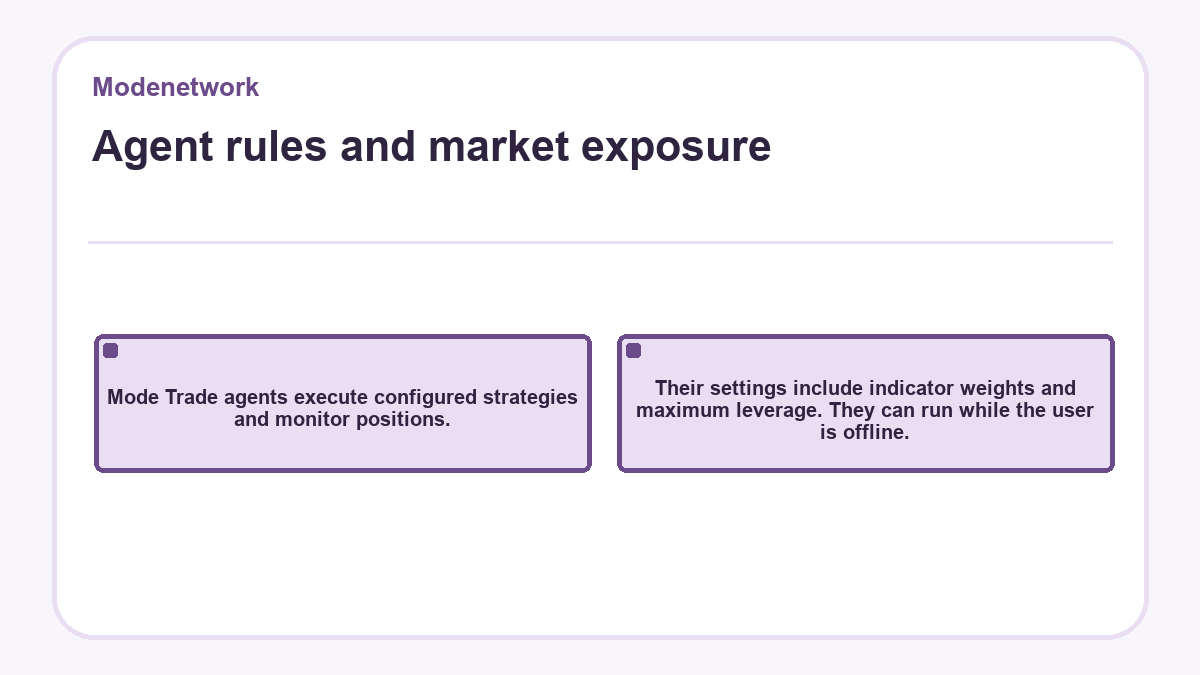
Mode Trade agents execute configured strategies and monitor positions. Their settings include indicator weights and maximum leverage. They can run while the user is offline.
How does the AI Terminal differ from the AI Quant?
The Mode AI Terminal prepares supported onchain actions, while the AI Quant supplies forecasting information for market analysis.
Natural-language requests let the terminal interpret an intended action and prepare the relevant transaction or contract interaction. Its functions include bridging, swaps and trading. The available integrations determine which actions it can prepare, so a request remains subject to the supported protocol functions.
Onchain actions that the terminal prepares require confirmation in a wallet. The terminal is experimental, so review the action presented for signing before authorizing it.
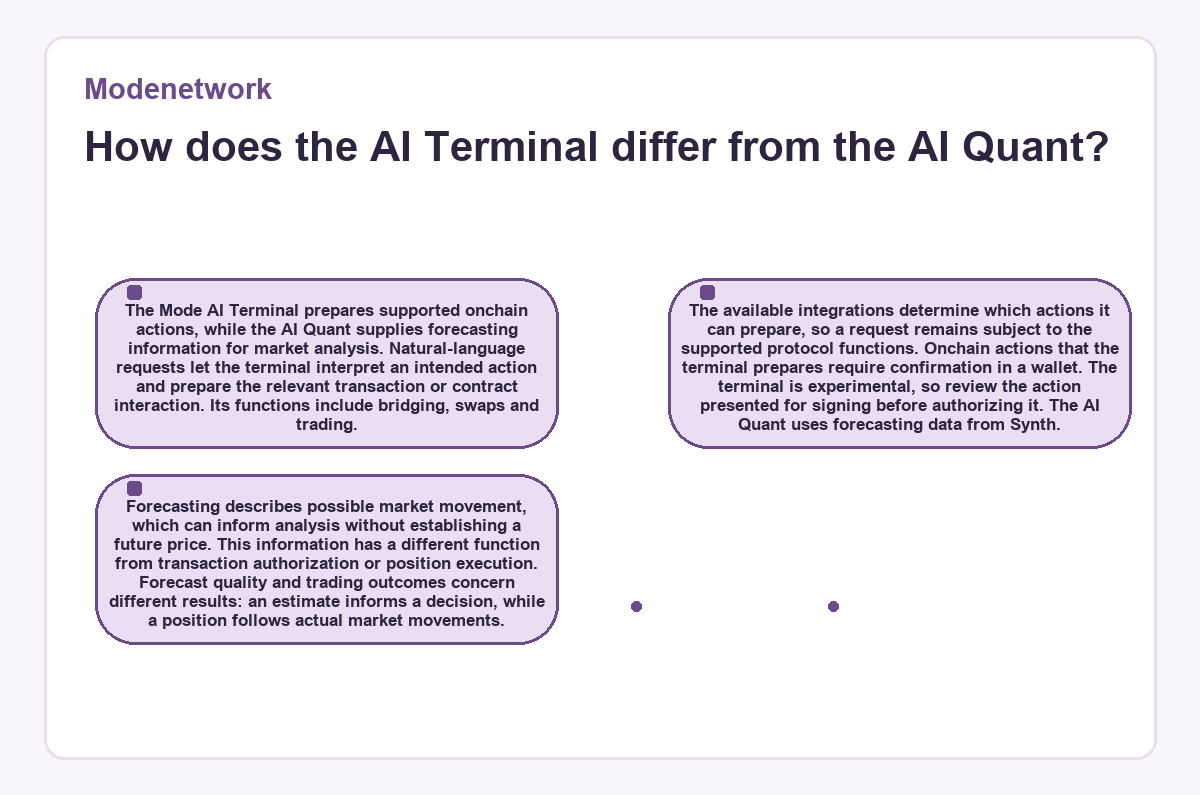
The AI Quant uses forecasting data from Synth. Forecasting describes possible market movement, which can inform analysis without establishing a future price. This information has a different function from transaction authorization or position execution. Forecast quality and trading outcomes concern different results: an estimate informs a decision, while a position follows actual market movements.
DeFi applications retain their own roles
Kim is a decentralized exchange built natively on Mode. Velodrome is an automated market maker (AMM). Balancer supplies tools for AMM experimentation. These applications support the exchange and liquidity side of DeFi. An AMM uses liquidity pools to support token exchange. Its pool design helps determine how that exchange operates, so shared network infrastructure does not make separate protocols identical.
LayerBank is a permissionless onchain bank. Sturdy v2 provides AI-powered yield-bearing vaults and yield aggregation. A vault applies a strategy to deposited assets, which gives it a different purpose from a trading position or a token swap. AI can form part of that strategy without removing the financial exposure of the assets involved. The application controls its own mechanisms and conditions, even when other ecosystem tools help users interact with it.
Mode does not control the code or content of third-party applications. The network's architecture and an application's contract behavior therefore need separate consideration. This distinction becomes especially relevant when a transaction assistant prepares an interaction with a partner protocol.
MODE staking and ETH restaking have different purposes
MODE staking supports votes for ecosystem protocols. This participation differs from paying ETH transaction fees and from the strategies that trading agents execute. Mode links ecosystem incentives to staking MODE, voting and using applications. OP rewards concern eligible participation in those programs, while vault yield arises from the financial strategy that a vault follows. A campaign allocation and a strategy's investment return have different meanings, even when an application displays both.
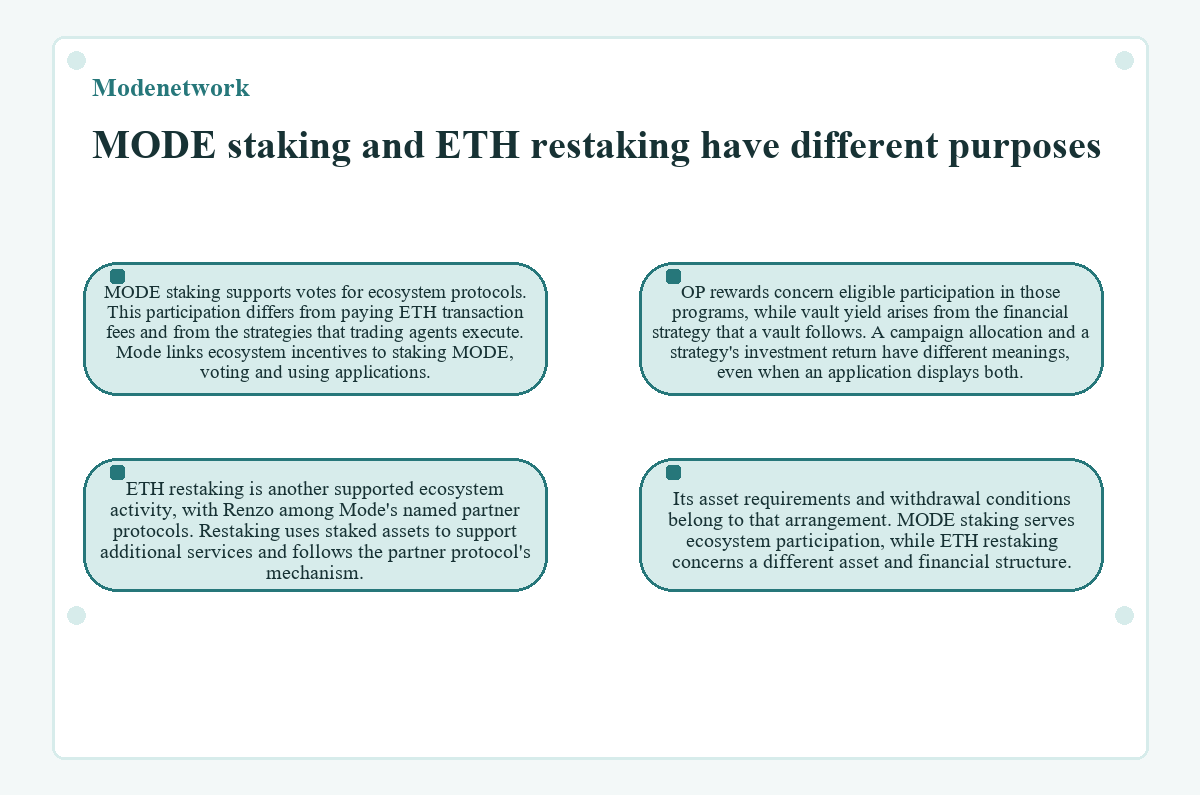
ETH restaking is another supported ecosystem activity, with Renzo among Mode's named partner protocols. Restaking uses staked assets to support additional services and follows the partner protocol's mechanism. Its asset requirements and withdrawal conditions belong to that arrangement. MODE staking serves ecosystem participation, while ETH restaking concerns a different asset and financial structure.
Building verifiable agents on the same network
Mode's developer focus includes verifiable trading agents, ERC-8004 integrations and verifiable AI tooling. The ERC-8004 proposal is a draft concerned with agent discovery and trust information. It proposes registries for identity, reputation and validation. Those records can support scrutiny of an agent's work, although registration alone does not establish that advertised capabilities function safely. The scope of an integration determines which information and checks a particular agent actually exposes.
The broader AI-to-AI vision covers agents coordinating financial tasks, including arbitrage, searches for maximal extractable value and smart contract auditing. These are development ambitions with different technical requirements. The available trading tools and transaction assistant each have narrower, concrete functions within that wider direction.
Existing Mode applications let users swap tokens or deposit assets into yield vaults. Building an agent adds the work of connecting market information, execution tools and the relevant verification mechanisms.
Modenetwork: the short answers
Can separate Mode Trade agents share a sub-account?
Each Mode Trade agent requires a separate funded sub-account. The setup allows one agent per sub-account, so multiple agents cannot share that trading environment.
Does pausing a Mode Trade agent close its open positions?
Pausing or deleting a Mode Trade agent stops it from opening new positions. That action does not automatically close existing trades. Take-profit or stop-loss conditions can still close those positions when triggered.
How can I inspect the reasoning behind an agent trade?
Mode Trade decision logs show the AI's reasoning, individual signal values, risk considerations and leverage decisions. They explain the choices behind agent activity, while portfolio metrics describe the financial outcome.
What identifies Mode Testnet in a wallet configuration?
Mode Testnet uses chain ID 919 and displays ETH as its currency symbol. That identifier distinguishes it from Mode Mainnet, even though both environments use the same currency symbol. The chain ID identifies the network, and the wallet connects through its configured RPC endpoint. The ETH label alone does not distinguish a test environment from the production network.
Is an advertised OP reward pool the amount each participant receives?
An OP reward pool covers incentives shared across eligible participants. Mode links participation to staking MODE, voting for protocols and using applications. An individual allocation follows the program's eligibility and distribution rules. A campaign's total budget does not specify how much one wallet earns.
Which indicators inform Mode Trade agent decisions?
Mode Trade agents assess market structure with Donchian Channels and momentum with MACD (moving average convergence divergence). Live market data and predefined risk logic also inform their decisions.
Can the AI Terminal read token balances and prepare spending approvals?
The Mode AI Terminal supports reading ERC-20 token balances and preparing token-spending approvals. Reading a balance supplies information, while an approval grants permission to spend the specified tokens. The approval's target and scope affect that permission.
Are Mode's original points seasons still open for participation?
Mode's Season 1 and Season 2 points campaigns have ended. Their points rules, multipliers and claim windows belonged to those campaigns. Staking or application incentives that operate under other programs use their own eligibility conditions.