 Modenetwork
 bridging - source confirmation and destination receipt
Modenetwork bridging is complete when the intended asset reaches the correct recipient on the destination chain. A successful source transaction confirms only that part of the transfer. For a canonical withdrawal from Mode, Ethereum proving and finalization remain separate requirements. A balance reduction, wallet signature or pending status does not establish receipt. Match the destination network and asset to the original request before using the funds for another transaction.
updatedThe destination asset must suit the intended transaction
The route must deliver an asset that the receiving application accepts within the time your task allows. A bridge request specifies a sending network, receiving network, recipient and asset. These details remain relevant after submission. Funds received on an unintended chain cannot fund the intended application, even when the recipient address looks identical. For tokens, the destination contract identifies the asset more precisely than its displayed name. For a Standard Bridge ERC-20 transfer, verify the token pair and its compatible bridged representation before authorizing the transfer. Different representations of one token are independent assets; choosing the wrong representation can permanently lock the original tokens. The Standard Bridge does not support fee-on-transfer or rebasing tokens because they can cause bridge accounting errors.
Preflight also covers spending permission and gas. The sending wallet needs the selected asset and enough native currency for the transactions that it must execute. A canonical withdrawal additionally requires Ethereum gas for its later actions. Keep those requirements separate from the amount being transferred. An expected incoming balance cannot pay an earlier transaction fee before the funds arrive.
Canonical deposits and withdrawals follow different paths
Mode's canonical bridge connects Ethereum Mainnet with Mode Mainnet, with different completion requirements in each direction. A deposit moves assets from Ethereum to Mode. A withdrawal moves them back to Ethereum. This bridge derives from Optimism's bridge architecture. Third-party bridges have their own supported routes and execution arrangements, so the canonical withdrawal conditions do not establish their delivery times.
A direct ETH transfer from an externally owned account to Mode's canonical bridge contract on Ethereum Mainnet credits the sending address on Mode. You must control that address on Mode to access the funds. An exchange-originated deposit can leave the assets unrecoverable when you cannot access the exchange's Mode wallet. This method applies only to ETH sent from Ethereum Mainnet. Sending from another network can cause unrecoverable asset loss. The restriction concerns that direct deposit mechanism, without excluding separate services designed for exchange transfers.
Network parameters for mainnet and testnet
Mode Mainnet and Mode Testnet have different chain IDs, even though both display ETH as their currency symbol. A chain ID does not establish that a selected bridge supports a particular asset or route. Mainnet and testnet receipts belong to different environments. A testnet balance therefore cannot establish mainnet delivery, and matching currency symbols do not make the balances interchangeable.
| Parameter | Value | Purpose | Network scope |
|---|---|---|---|
| Mainnet chain ID | 34443 | Identifies the receiving or sending chain | Mode Mainnet |
| Mainnet currency symbol | ETH | Names the native currency | Mode Mainnet ETH |
| Testnet chain ID | 919 | Identifies the testing chain | Mode Testnet |
| Testnet currency symbol | ETH | Names the test environment's currency | Mode Testnet ETH |
Authorization and asset movement
Signing a transaction authorizes its contents. Broadcasting submits it to the network.
A successful conventional ERC-20 approval sets an allowance that permits a specified spender to use tokens. The approval does not itself move those tokens through the bridge. A signed transaction that has not been broadcast also leaves the blockchain state unchanged.
For an ERC-20 token that is native to its sending chain, a successful bridge call locks it once the Standard Bridge has a sufficient allowance. Successful execution of the resulting cross-chain message mints its representation to the recipient. Its return path burns the bridged representation and releases the original asset. The bridge can burn its own representation without that preliminary allowance. Native ETH transfer has no ERC-20 approval.
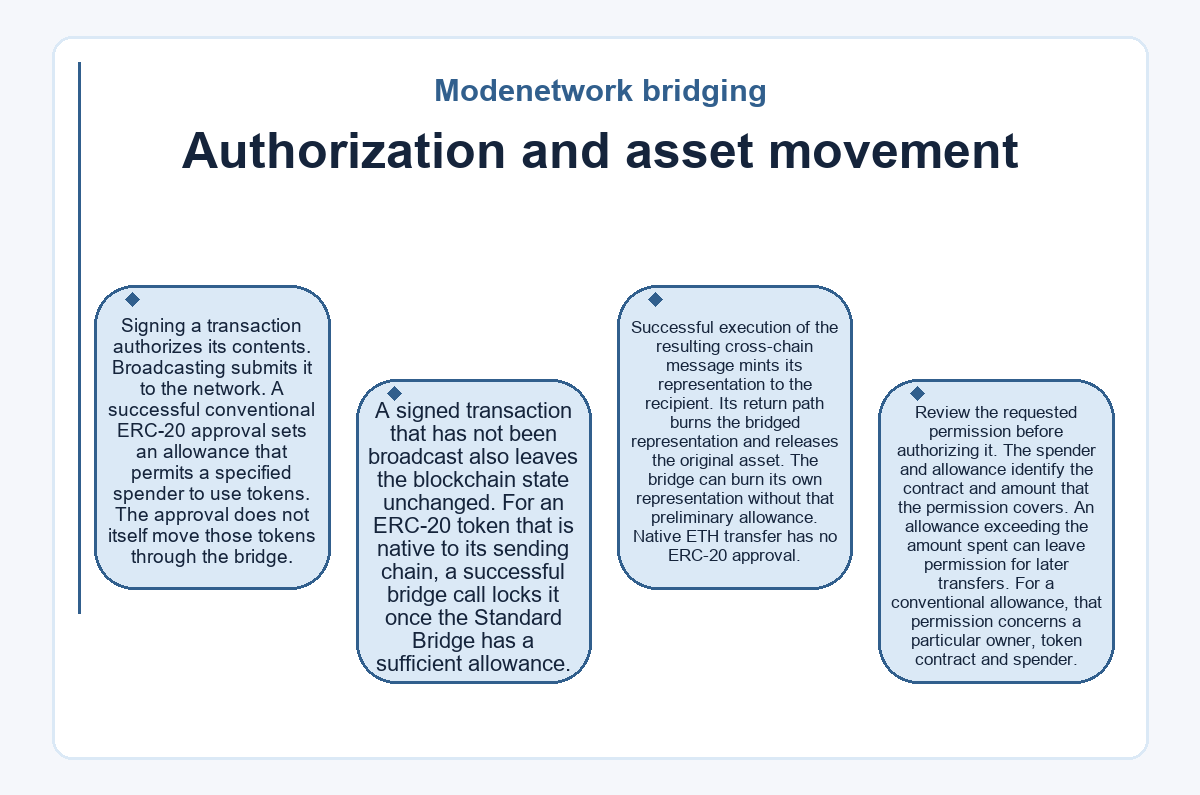
Review the requested permission before authorizing it. The spender and allowance identify the contract and amount that the permission covers. An allowance exceeding the amount spent can leave permission for later transfers. For a conventional allowance, that permission concerns a particular owner, token contract and spender.
Source receipts and bridge message progress
A transaction hash identifies a transaction for tracking.
Source-side acceptance requires evidence that the relevant bridge initiation executed on the sending chain. A transaction receipt records execution on the chain that processed that transaction. An approval receipt concerns permission, while a bridge initiation receipt concerns the transfer request. Inspect the operation that produced the receipt. A successful approval cannot establish that a later bridge call occurred. For a canonical transfer, cross-chain messaging connects the sending contract to the receiving contract. The source transaction and its message therefore belong to the same transfer, although they describe different parts of its execution.
An in-progress status needs that same connection to the original request. The record should identify the route and recipient, with the transferred amount and asset matching the request. Source inclusion can coexist with an unfinished destination action. The remaining work depends on the transfer direction and mechanism.
What does an initiated Mode withdrawal still require?
An initiated canonical Mode withdrawal still needs proving, the applicable waiting period and successful finalization on Ethereum. Before proving becomes possible, Ethereum needs a published commitment covering the relevant Mode state. That dependency explains why a withdrawal may remain unready to prove after its source transaction succeeds.
In Mode's Bedrock canonical withdrawal flow, the seven-day waiting period starts after the withdrawal is proven on Ethereum. Waiting from the initial Mode transaction does not establish that the proof has occurred. This timing condition belongs to that withdrawal flow, rather than every route that transfers assets away from Mode.
Proving establishes the withdrawal's inclusion; it does not itself deliver the withdrawn asset to its recipient. The proof and finalization are Ethereum transactions. ETH held only on Mode cannot pay their Ethereum gas fees. Readiness to claim also differs from a claim that has executed successfully.
Finalization follows the required wait and relays the withdrawal on Ethereum. The receiving asset and recipient must still match the request. A calendar estimate cannot replace the withdrawal's actual eligibility to finalize, especially when the expected proof is missing or the applicable state commitment has changed.
Destination execution and the recipient balance
Destination completion requires the requested asset to reach the intended recipient on the correct receiving chain. For an ERC-20 transfer, the relevant token contract's transfer records and recipient balance help establish delivery. Native ETH needs a native balance check. ETH deposited through Mode's canonical bridge remains native ETH on Mode, so a wrapped-token balance would describe a different asset.
The outer transaction status may need interpretation. A contract can record whether an internal call succeeded, and a withdrawal finalization event includes its execution outcome. Where the transfer uses that mechanism, a successful enclosing transaction alone cannot establish a successful payout. Connect the outcome to the specific withdrawal and recipient, then distinguish receipt from any later action that spends the balance.
Reconciling transferred amounts with gas spending
Reconciliation compares the asset and amount received with the transfer request, while accounting separately for fees and other wallet activity. The quoted input, expected output and final received amount represent different observations. Where a route quotes deductions, its output terms determine the expected receipt. A quote still cannot establish that the quoted output has arrived.
Native ETH needs particular care because it can be both the transferred asset and the currency spent on gas. Ethereum proof and claim transactions can reduce the same wallet's ETH balance while an incoming withdrawal increases it, so a net balance change alone can obscure the transferred amount when those operations occur within the interval being compared. The transaction records explain those separate movements.
For ERC-20 assets, compare amounts using the correct token contract and decimal interpretation. An unrelated incoming payment or subsequent spend can also change the recipient's total balance. The transfer record ties the received quantity to its operation; the balance establishes what remains available. Keep fee estimates separate from fees actually paid.
Missing receipt, missing proof and failed execution
A pending source transaction has no completed execution receipt.
A failed source execution does not establish bridge acceptance. An approval that succeeded with no bridge initiation leaves a different gap. Those states require attention to the source operation. Neither establishes that the receiving chain has begun processing the requested transfer. A canonical withdrawal awaiting proof needs a published state commitment that includes it and a successful proving transaction on Ethereum. A proven withdrawal still inside its waiting period must wait until it is eligible to finalize. A failed finalization requires its execution outcome to be examined. Refreshing a status display cannot supply a missing transaction or change the contract's withdrawal conditions.
Repeated balance checks should keep the destination chain, recipient and asset fixed. Otherwise a different network or token display can make receipt appear to change without a new transfer. Avoid creating a second bridge request merely because the first remains incomplete. A new request creates another operation to reconcile and does not repair the earlier one.
Route suitability before the next operation
A task requiring receipt before the canonical waiting period ends cannot use that withdrawal flow to meet its deadline. Third-party bridges have their own asset support and security assumptions. Their current availability, fees and delivery conditions need assessment for the selected route. A different route's quote does not shorten an already initiated canonical withdrawal.
The Mode AI Terminal includes bridging among its transaction functions. That entry point does not establish that every possible route or asset is supported, and a prepared instruction does not prove destination receipt. Bridging into Mode also remains separate from swapping an asset or creating a staking position. Those operations need their own accepted assets and successful execution. If the funds are already available on the required chain, another cross-chain transfer may be unnecessary.
Practical questions about Modenetwork bridging
Does adding Mode to a wallet automatically select it for a bridge transaction?
Adding a network does not necessarily make it the wallet's active chain. The wallet_addEthereumChain method adds chain information without requiring an automatic switch. A successful add-network response therefore cannot establish which network a later bridge transaction uses. The selected chain must match the sending side of that transaction.
Will revoking an ERC-20 allowance cancel a Mode bridge transfer that already executed?
Revoking an allowance changes future spending permission without undoing an executed transfer. An allowance controls how many tokens a specified spender may use. Once a bridge operation has executed, reducing that allowance does not reverse its asset movement or cancel its cross-chain message. Any remaining transfer action follows the selected bridge's mechanism.
Is a rejected Mode bridge request charged the same gas as a reverted transaction?
A request rejected before execution incurs no execution gas, while an included transaction that reverts can consume gas. Rejecting a wallet prompt does not itself execute a transaction. An Ethereum transaction that runs out of gas during execution consumes the gas provided. An earlier approval remains a separate charge if it already executed.
Can an RPC provider see my address while I monitor a Mode transfer?
An RPC provider can receive your IP address and the blockchain activity that your requests reveal. RPC means remote procedure call. Address balance queries and transaction lookups can expose what you are checking. Changing the bridge's visible interface does not necessarily change the RPC service through which the wallet communicates.
Who can submit the Ethereum proof for a canonical Mode withdrawal?
A canonical Mode withdrawal proof can be submitted by a relayer other than the initiating account. The proof must still establish the specified withdrawal's inclusion, and finalization must use its recorded data. A different submitting account does not gain permission to substitute another recipient or alter the amount being withdrawn.