 Modenetwork
 builds agent infrastructure with draft ERC-8004, which separates discovery from optional trust models
Modenetwork connects its verifiable AI agent infrastructure with draft ERC-8004, a framework for agent discovery and optional trust models. The draft's Identity Registry identifies agents and points to their registration files. Reputation and validation supply separate trust mechanisms. A discoverable record can therefore identify an agent without establishing the reliability of its work.
updatedMode develops these agents for its Layer 2 network and Mode Trade perpetuals exchange. Registration data identifies an agent, service protocols enable communication and evaluations supply evidence about the work that it performs.
An empty supportedTrust field leaves an ERC-8004 registration useful for discovery without declaring a trust model.
Mode agents and ERC-8004 registries serve different functions
Mode's Layer 2 provides an execution environment, while Mode Trade supplies a perpetuals trading application. Their agents are software that performs supported financial tasks, while ERC-8004 identifies agents across organizational boundaries and attaches information to them. Its Identity Registry holds the agent handle, client feedback enters the Reputation Registry and the Validation Registry records assessments of submitted work. These registry functions complement the application in which an agent operates. They do not specify the agent's trading strategy or the exchange's market rules.
Bridging and MODE staking belong to the wider Mode ecosystem. Each activity retains its own transaction conditions, alongside the identity and trust information that an agent record supplies. Payments also sit outside the draft's registry functions; an advertised payment wallet identifies a recipient without defining a payment protocol.
An agent identifier connects the registry to a registration file
The draft Identity Registry uses ERC-721 with the URIStorage extension for agent registration. An agent's global identity combines its agentId with registry context that includes the chain family, chain ID and registry contract address. A populated agentURI points to a registration file that describes the agent and lists advertised services. These identifiers connect the description to an onchain record. A name alone cannot establish that connection because registrations belong to particular chains and contracts. Applications need the full identity to associate service information with the intended agent.
MCP and A2A communicate through advertised services
Model Context Protocol, or MCP, lets a service list capabilities such as tools and resources. Agent2Agent, or A2A, handles agent authentication and communication, including coordination throughout a task's lifecycle. ERC-8004 adds discovery and trust mechanisms that those communication protocols do not inherently provide. A registration file can advertise endpoints for either protocol. The developer chooses the endpoint types that describe how software can contact the advertised service. Service compatibility concerns communication; reputation and validation concern evidence about the agent's work.
What does an agent's advertised trust model tell you?
The optional supportedTrust field names the trust models that an agent advertises, while evidence determines what those models demonstrate. Its entries can describe reputation-based evaluation, cryptoeconomic validation or trusted execution environment attestation, each pointing to a particular evaluation approach. It does not supply the feedback, proof or validator response that makes that approach useful.
An absent or empty supportedTrust field means discovery-only use. The agent can still publish an identity and advertised service endpoints.
Client feedback and independent validation contribute different information. Reputation records what particular clients report about an agent, while validation evaluates submitted work through a selected checking method. The draft allows methods such as stake-secured re-execution and zero-knowledge machine learning (zkML). Trusted execution environment (TEE) oracles provide another supported approach. These alternatives need not share the same assumptions. A validator that reruns a task and a verifier that checks a cryptographic proof reach conclusions through different mechanisms. The meaning of their responses follows the method that they apply.
A validation request concerns submitted inputs and outputs, while reputation can describe previous service behavior. The information that they establish is limited to the stated task or measurement context.
Updating agentURI lets an owner change the registration file linked to the existing identity. Published descriptions can therefore change while the registered agent retains its identifier.
A discovery-only record supplies a contact point
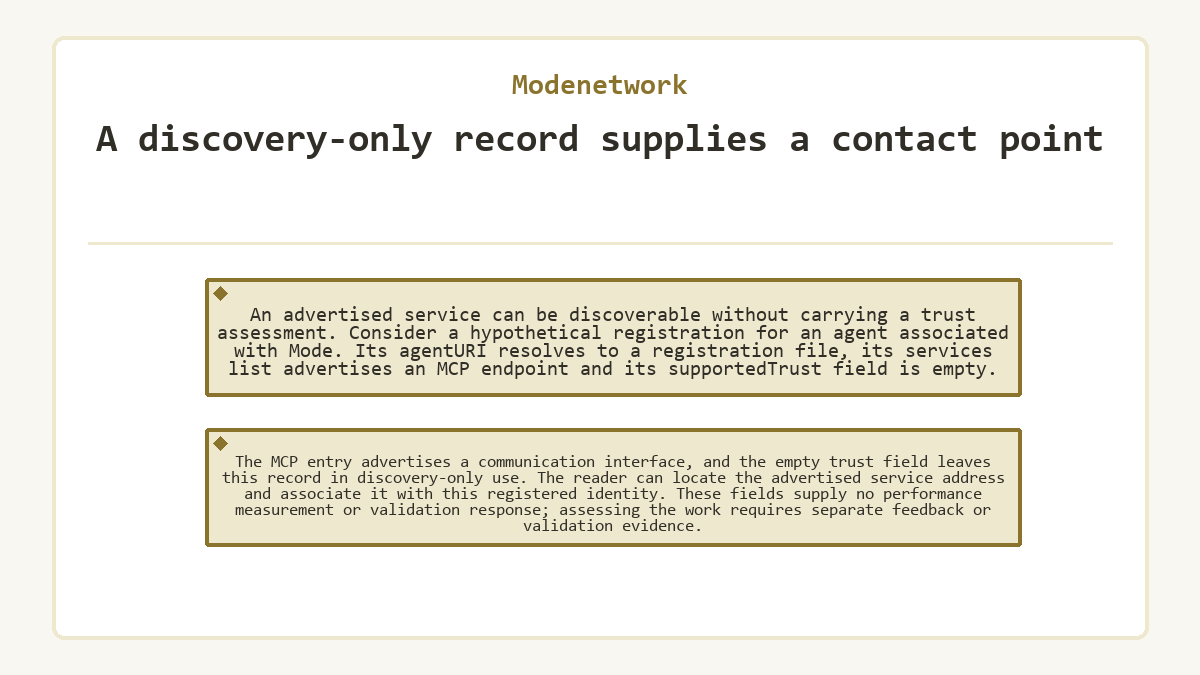
An advertised service can be discoverable without carrying a trust assessment. Consider a hypothetical registration for an agent associated with Mode. Its agentURI resolves to a registration file, its services list advertises an MCP endpoint and its supportedTrust field is empty.
The MCP entry advertises a communication interface, and the empty trust field leaves this record in discovery-only use. The reader can locate the advertised service address and associate it with this registered identity. These fields supply no performance measurement or validation response; assessing the work requires separate feedback or validation evidence.
Feedback preserves the author's measurement and context
Client feedback contains a numeric value and decimal precision, so a displayed number needs its measurement context. Tags can describe the measured property, and an endpoint field can identify the service that the feedback concerns. The numeric value and valueDecimals are required; tags and supporting offchain information are optional. The draft permits valueDecimals from 0 to 18. A reputation interface needs enough context to distinguish measurements of availability, response time or trading yield because those quantities have different meanings.
The draft bars an agent's owner and approved operators from submitting feedback for that agent. Reviewer selection still matters when an application combines feedback; the reputation summary method requires a nonempty list of client addresses. Filtering by authors helps address spam and Sybil activity, where multiple controlled identities can distort a reputation. Filtering by client addresses and tags can keep a summary tied to the service property being examined.
Who can validate an agent's submitted work?
The validator named in a validation request is the only party permitted to submit that request's validation response. The request must come from the agent's owner or operator and point to offchain data with the inputs and outputs needed for evaluation. Its requestHash identifies the request and commits to that payload. A recorded request shows that an assessment was requested; the validator's response, when submitted, expresses its assessment of this particular work.
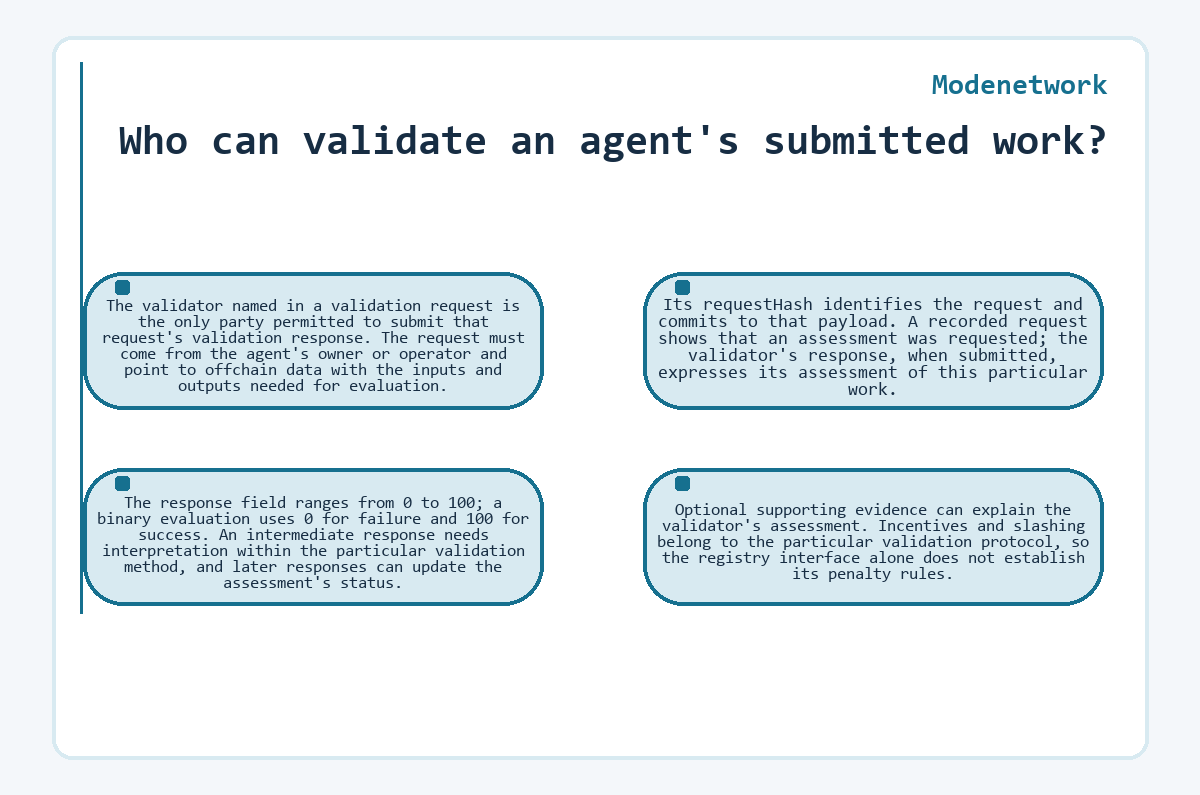
The response field ranges from 0 to 100; a binary evaluation uses 0 for failure and 100 for success. An intermediate response needs interpretation within the particular validation method, and later responses can update the assessment's status. Optional supporting evidence can explain the validator's assessment. Incentives and slashing belong to the particular validation protocol, so the registry interface alone does not establish its penalty rules.
Registration, validation and trading performance answer different questions
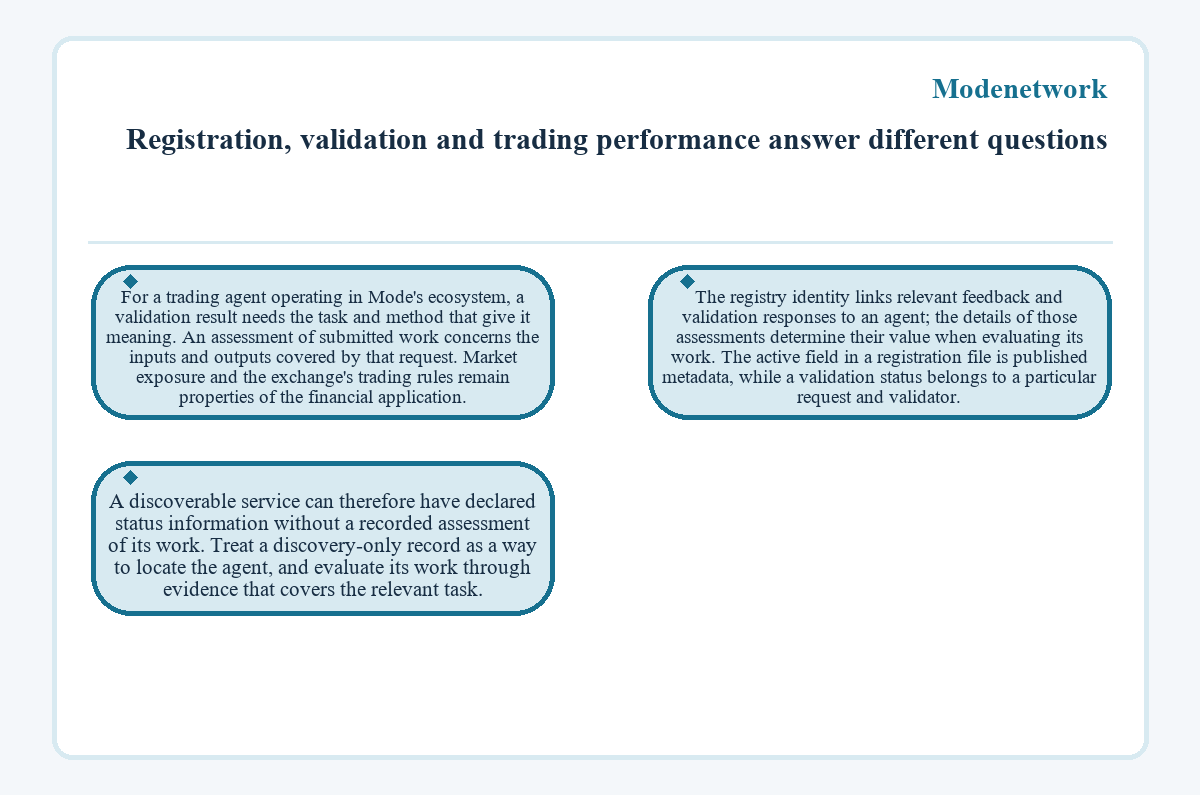
For a trading agent operating in Mode's ecosystem, a validation result needs the task and method that give it meaning. An assessment of submitted work concerns the inputs and outputs covered by that request. Market exposure and the exchange's trading rules remain properties of the financial application. The registry identity links relevant feedback and validation responses to an agent; the details of those assessments determine their value when evaluating its work.
The active field in a registration file is published metadata, while a validation status belongs to a particular request and validator. A discoverable service can therefore have declared status information without a recorded assessment of its work. Treat a discovery-only record as a way to locate the agent, and evaluate its work through evidence that covers the relevant task.
Practical questions
-
Can an ERC-8004 registration for a Modenetwork agent advertise services on another chain?
- An ERC-8004 registration can advertise endpoints or agent wallets on chains where the agent has no registration. The registry identity still includes the chain and contract that issued it. An advertised endpoint describes a service connection; the registration does not itself establish compatibility with every listed chain. This flexibility belongs to the draft registry format and does not mean that every Mode application supports cross-chain execution.
-
Does transferring an agent registration preserve its payment wallet?
- Transferring an ERC-8004 agent clears its agentWallet field, so the new owner must reverify a payment wallet. The draft represents the cleared state with the zero address. This field identifies the address where the agent receives payments. The dedicated setAgentWallet method requires an EIP-712 signature for an externally owned account or ERC-1271 verification for a smart contract wallet.
-
How can an agent prove control of its advertised HTTPS endpoint?
- An agent can optionally prove control of an HTTPS endpoint domain by publishing a matching file at /.well-known/agent-registration.json on that endpoint domain. The file must be reachable over HTTPS and contain a registrations entry whose agentRegistry and agentId match the onchain agent. If the endpoint uses the same domain as the primary registration file linked by agentURI, the additional check is unnecessary. This establishes endpoint-domain control without evaluating the quality of the service.
-
Is a registration file required at the moment an ERC-8004 agent is minted?
- The draft permits minting an ERC-8004 agent before its agentURI is supplied. Its register overload without arguments creates the registered identity, and setAgentURI can attach the registration-file location later. A minted identifier establishes the registry identity. Until a usable agentURI resolves to a registration file, the identifier alone supplies no advertised service information from that file.
-
Can a client withdraw ERC-8004 feedback after submitting it?
- A client can revoke feedback that it previously submitted through the draft's revokeFeedback method. The stored record then carries a revoked status. The readAllFeedback interface omits revoked feedback by default, although its includeRevoked parameter allows callers to include it. Revocation therefore affects the feedback that an application counts or displays according to its chosen read settings; it does not require every application to present the same summary.