 Modenetwork
 staking suits MODE voting when withdrawal delays fit your plans
Modenetwork staking lets MODE holders gain veMODE voting power and help direct OP incentives to eligible ecosystem recipients. It fits a governance task when funds can remain staked through the relevant warm-up and withdrawal conditions. A new deposit does not immediately make the position eligible to vote or make an OP reward claimable. The position's eligibility, recorded voting activity and reward allocation each answer a different question. Funds needed for immediate spending fit poorly with that commitment.
updatedAn eligible vote connects staking with participation rewards
A MODE stake qualifies for voting incentives only when it meets the participation rules of the relevant reward program. Gauge voting distributes influence among eligible recipients that compete for ecosystem incentives. A gauge is the voting destination associated with a recipient. Season 5 included applications, agents and streamers as potential incentive recipients. The amount staked and the votes assigned affect different parts of participation: the stake supports voting power, while an allocation expresses which recipient that power supports.
Season 3 tied an epoch's OP reward eligibility to staking and voting in the prior epoch. That condition explains why a deposit record alone cannot establish entitlement to a voting reward. Protocol incentives also differ from voter rewards: a protocol receives funding to distribute through its eligible activities, while a voter receives any allocation earned under the voter program.
MODE and pool tokens lead to different voting positions
MODE staking produces veMODE, while the pool-token route used in Season 4 produced veBPT from an 80/20 MODE/ETH Balancer position. BPT means Balancer Pool Token; it represents a liquidity-pool position. The ve prefix identifies voting-escrow participation. These inputs expose the holder to different underlying assets, so the presence of a BPT staking option does not make every pool token eligible. The Mode Governance Hub offers separate MODE and BPT choices.
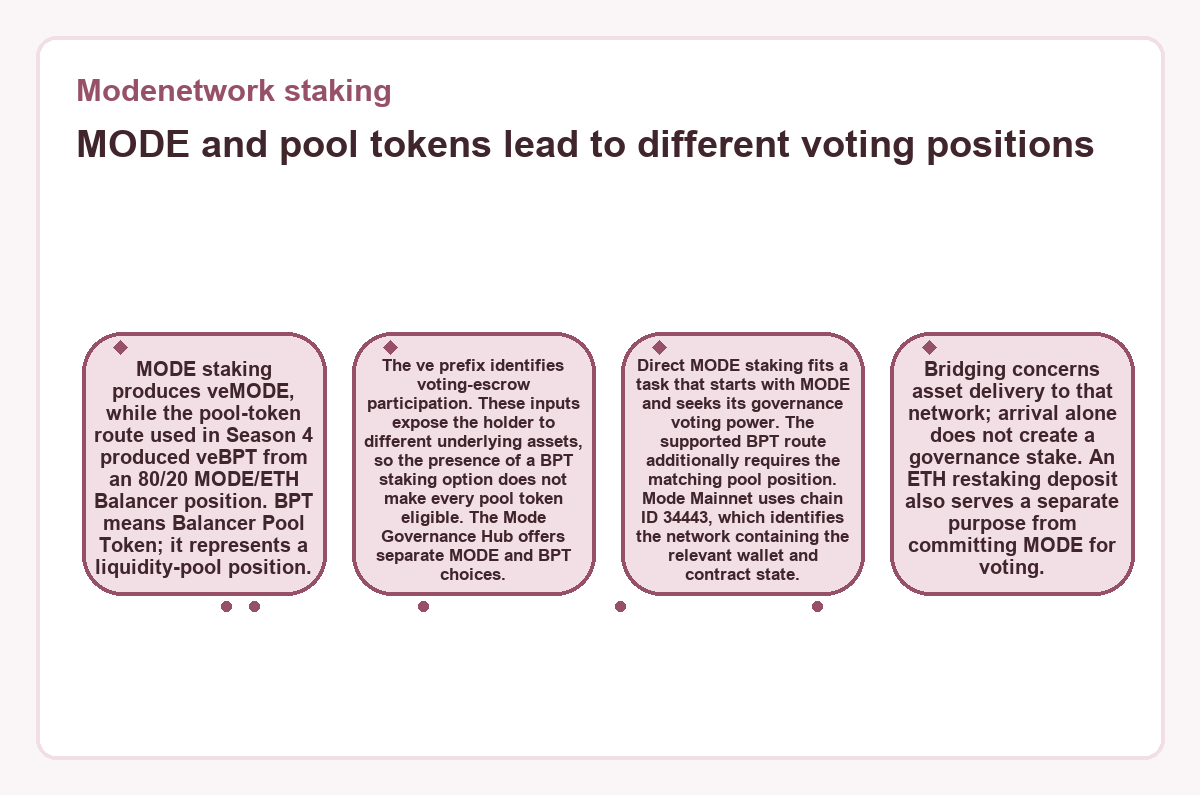
Direct MODE staking fits a task that starts with MODE and seeks its governance voting power. The supported BPT route additionally requires the matching pool position. Mode Mainnet uses chain ID 34443, which identifies the network containing the relevant wallet and contract state. Bridging concerns asset delivery to that network; arrival alone does not create a governance stake. An ETH restaking deposit also serves a separate purpose from committing MODE for voting.
Can a new MODE stake vote immediately?
A new MODE stake must complete its warm-up before voting, so a deposit near a deadline can miss the intended voting window.
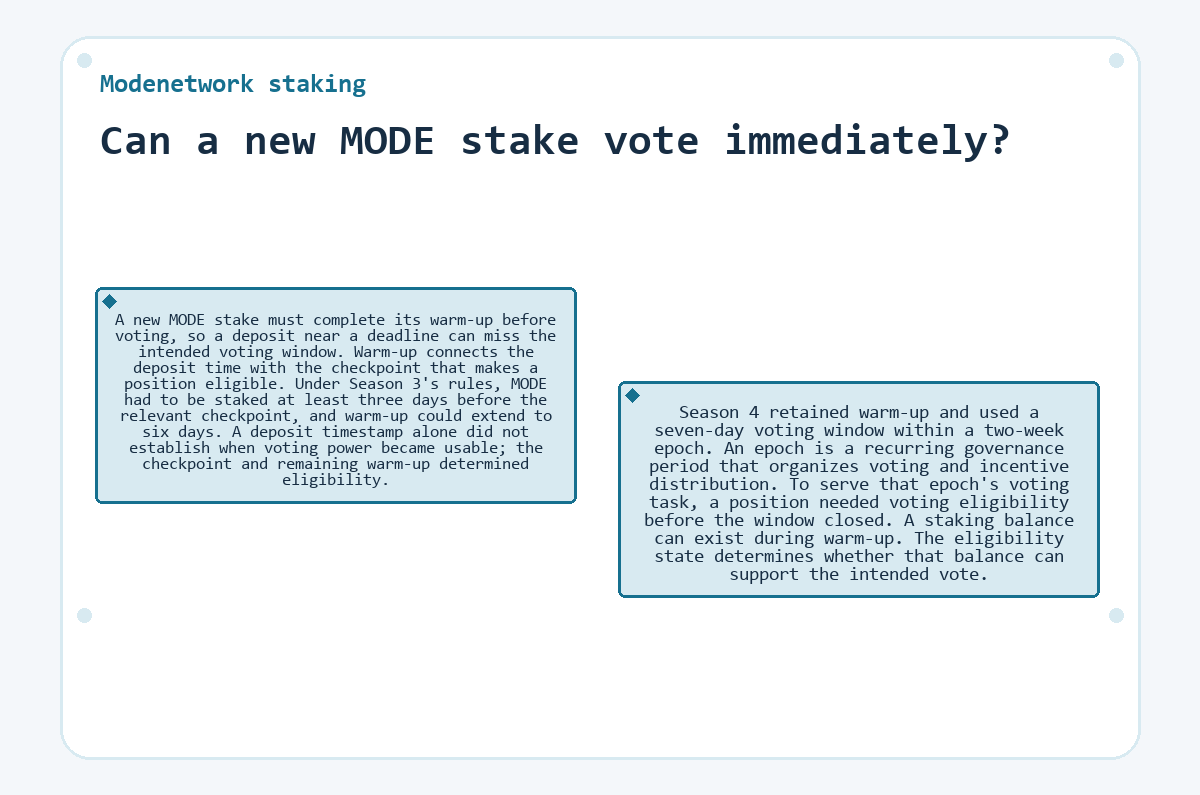
Warm-up connects the deposit time with the checkpoint that makes a position eligible. Under Season 3's rules, MODE had to be staked at least three days before the relevant checkpoint, and warm-up could extend to six days. A deposit timestamp alone did not establish when voting power became usable; the checkpoint and remaining warm-up determined eligibility.
Season 4 retained warm-up and used a seven-day voting window within a two-week epoch. An epoch is a recurring governance period that organizes voting and incentive distribution. To serve that epoch's voting task, a position needed voting eligibility before the window closed.
A staking balance can exist during warm-up. The eligibility state determines whether that balance can support the intended vote.
Withdrawal delays limit access to committed MODE
A MODE governance stake must satisfy its warm-up and cooldown conditions before tokens become withdrawable.
Season 4 allowed cooldown requests at any time during an epoch and described a cooldown of three to six days. That flexibility concerned when an eligible exit could begin. Token retrieval followed cooldown completion. A request to exit and the later withdrawal therefore represented different outcomes, even though both belonged to the unstaking process.
Starting that Season 4 exit also removed the position's votes and moved its staking NFT into an exit queue. The NFT represented the staked governance position. An exit-queue entry showed that redemption remained outstanding; it did not establish that MODE had returned to the wallet.
The applicable position state governs withdrawal eligibility; an old duration cannot establish a newer position's release time.
The AI Terminal changes how staking requests are prepared
The Mode AI Terminal supports preparing MODE staking and unstaking requests, along with checking existing staked positions through natural-language instructions. For an onchain action, it prepares a transaction or contract interaction for wallet confirmation. The Terminal is experimental; check the proposed action before signing, and do not sign if you do not understand it. Any requested token allowance concerns permission to spend MODE; the staking position records the actual commitment.
Manual governance controls suit examining the position and its voting allocation directly. Terminal assistance offers another way to prepare supported staking operations. A warm-up restriction remains effective with either approach; the Terminal's unstaking function can fail while a position is warming up.
How does a longer MODE stake change voting power?
Longer staking can increase the voting power multiplier, up to a maximum of 6x under Season 4's rules. That multiplier measures governance influence, so its growth does not establish an equivalent investment return. Season 5 carried voting power forward from Season 4, making the program transition relevant to an existing position. A multiplier belongs to its governance arrangement; the position's applicable rules determine its progression across a later transition.
The voting deadline determines whether commitment fits
Assume MODE is available in the wallet and the aim is to direct incentives during a particular voting window. Compare committing it to governance with keeping it available for spending. The choices use the same asset but produce different access conditions and participation records.
- If the window allows warm-up and the wallet has ETH on Mode Mainnet for transaction fees, staking can establish the position needed for veMODE voting.
- If the MODE must remain spendable before withdrawal eligibility, retaining it outside staking avoids the governance exit delay.
- Once the position is eligible, assign votes to an eligible gauge during the open voting window. Confirm that the chosen allocation is recorded.
- For the spending task, MODE must remain in the wallet's available balance; a queued withdrawal does not meet that condition.
- If the window closes before an eligible vote is recorded, a deposit alone cannot complete that voting task.
A wallet signature or transaction hash alone does not establish the gauge's recorded vote.
Does a reward estimate establish what you can claim?
A displayed reward estimate does not establish claimable OP for an eligible wallet, because the allocation must satisfy the applicable reward conditions. An annualized percentage expresses a rate across a year; it does not specify a particular position's payable token amount. The reward period and the wallet's eligible participation remain relevant. A longer commitment or a larger stake cannot independently establish a fixed payment.
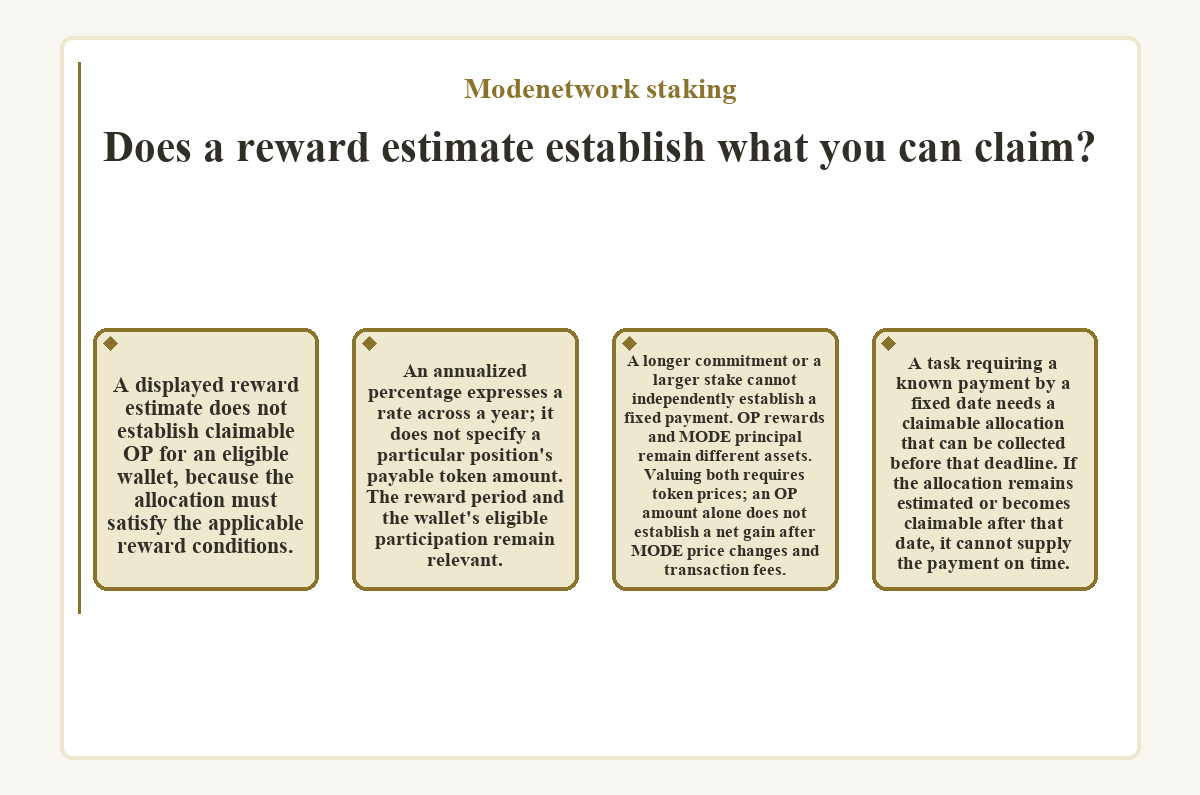
OP rewards and MODE principal remain different assets. Valuing both requires token prices; an OP amount alone does not establish a net gain after MODE price changes and transaction fees. A task requiring a known payment by a fixed date needs a claimable allocation that can be collected before that deadline. If the allocation remains estimated or becomes claimable after that date, it cannot supply the payment on time.
Modenetwork staking: reader questions
Do I need ETH as well as MODE for governance transactions?
ETH pays ordinary transaction fees on Mode Mainnet, while MODE supplies the asset committed to a veMODE stake. A MODE balance alone therefore does not cover the network fee. The fee depends on the transaction and network conditions, so a percentage of the MODE deposit is not a reliable substitute for the wallet's fee estimate.
Will revoking a MODE allowance release tokens that I have already staked?
Revoking a spending allowance does not withdraw MODE that has already entered a staking position. An ERC-20 allowance controls a spender's permission to transfer tokens from the approving account. Withdrawal instead follows the staking position's exit conditions. Changing the permission does not replace an eligible unstaking or redemption action.
Can an incentive recipient lose gauge eligibility after winning votes?
Winning votes does not establish continued gauge eligibility for later rounds. Season 5 required recipients to explain how they distributed OP incentives. Season 4 allowed disabling a gauge when its required distribution plan or reporting was missing. Eligibility belongs to the recipient and the applicable program, so earlier support does not settle a later round.
Do Season 2 MODE/USDC staking rules apply to veMODE voting?
Season 2's MODE/USDC staking arrangement had different inputs and reward rules from later voting-escrow governance. It accepted MODE or MODE/USDC Balancer Pool Tokens and specified a seven-day unstaking cooldown. Season 4's veBPT input was the 80/20 MODE/ETH pool token. The BPT label does not make these pool tokens interchangeable or transfer their exit rules.
Are claimed OP rewards automatically part of my staked MODE principal?
Receiving OP does not, by itself, add MODE to a governance stake. OP and MODE are separate tokens, so compounding an OP reward into MODE involves conversion and staking. A reward claim alone cannot establish that those operations occurred. The staked MODE position must show the added principal before it counts as an increased stake.
Can I check my MODE stake without signing a transaction?
A public contract read through eth_call does not require a transaction signature. The method executes a contract call without adding a transaction to the blockchain. Its response concerns the queried network, contract and account. Reading a position therefore differs from authorizing a change to its stake, votes or withdrawal state.